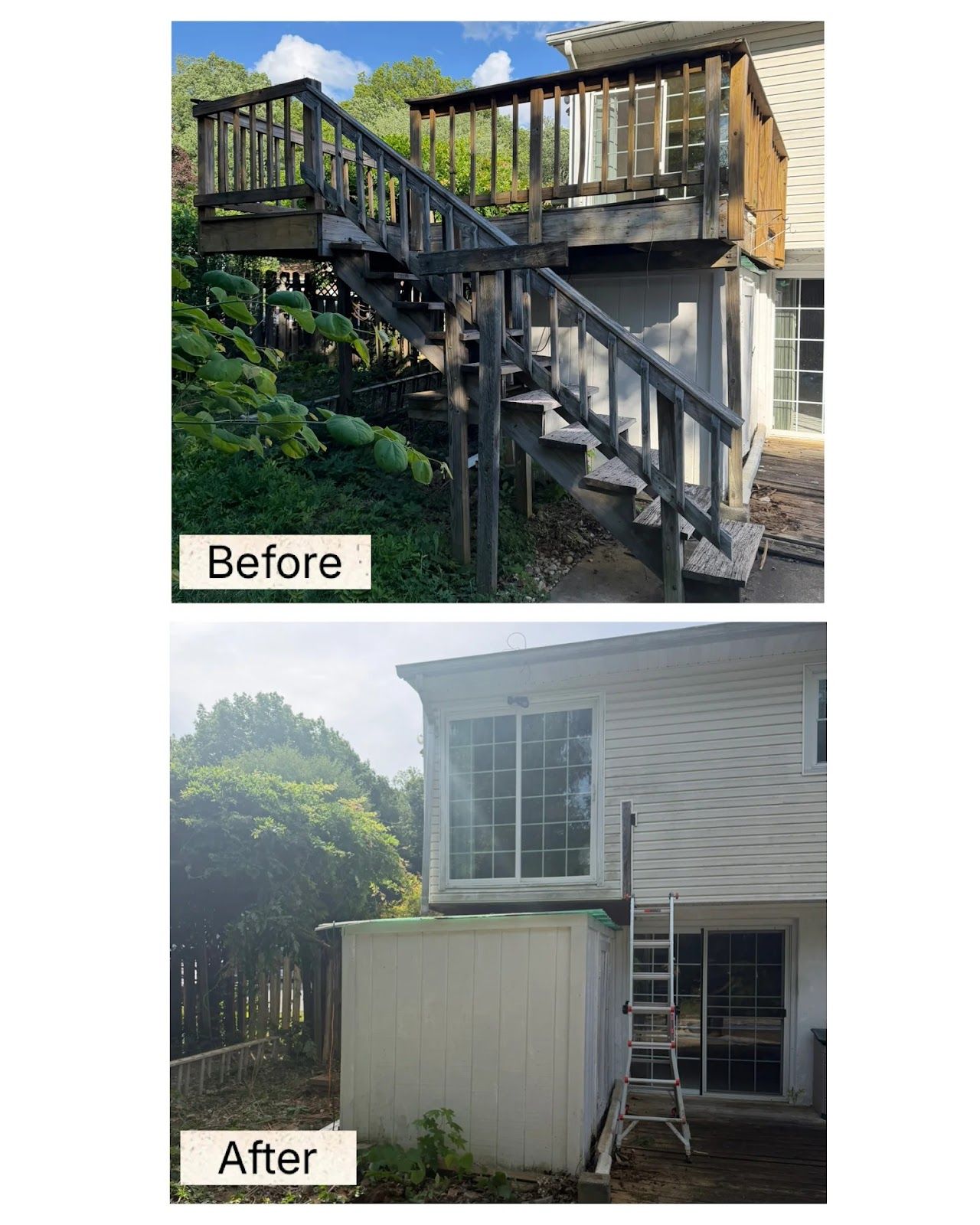
Rotting Structures Taken Down and Hauled Away
Deck demolition in Fredericksburg for rotting, unstable, or structurally failed decks attached to residential properties
Decks built on Fredericksburg homes in the 1980s and 1990s were commonly framed with pressure-treated lumber that has long exceeded its rated service life, and the ledger board connections tying those decks to the home's rim joist frequently show the earliest signs of structural failure—rot that travels inward behind the siding and compromises the connection before surface boards give any visible warning. Anderson Removal LLC handles deck demolition in Fredericksburg with the owner managing every aspect of the dismantlement personally, with specific attention to protecting home siding and foundation from damage during removal of structures that are directly attached to the house.
Dismantling a deck that has rotted at the ledger connection or along the post bases requires careful sequencing rather than simple board-by-board teardown. The structure must be supported and controlled as each section is removed to prevent the remaining framing from shifting suddenly toward the house exterior. Anderson Removal carries insurance coverage for deck demolition work, which reflects the real risk that adjoining siding and foundation materials face when an attached structure is removed without protective measures in place.
Schedule an on-site evaluation to assess the deck's condition and determine what protective steps the demolition will require before work begins.
Why Deck Removal Requires More Than Teardown
A deck demolition job is finished when the yard is completely clear—not when the structure is down. All wood, nails, hardware, post anchors, and concrete footings that are accessible above grade are loaded and removed in the same visit as the teardown. Leaving fasteners and broken lumber in the grass creates hazards that persist for months, particularly on properties where children or pets use the yard regularly. The removal phase is as deliberate as the dismantlement itself.
After the work is complete, the area where the deck stood is open and level, with the house exterior intact at the former attachment point. Homeowners replacing the deck with a new structure, converting the space to a patio, or simply reclaiming the yard can proceed without a secondary cleanup step. Garrisonville properties with larger lot sizes and multiple outbuildings benefit from this complete removal approach because debris from a partial teardown can interfere with adjacent structures and yard use for an extended period.
The scope of a deck demolition includes the full above-grade structure: decking boards, framing, railings, stairs, and post hardware. Below-grade concrete footings may require separate permitting or equipment depending on depth; the owner assesses footing conditions during the pre-job evaluation and clarifies what is covered before work begins.
Questions Before Starting Your Project
Deck demolition raises specific questions about how the work is sequenced and what protections are in place when an attached structure is being removed from a home.
How is the home's siding protected when a deck attached to the ledger board is removed?
The ledger connection is the last point of attachment addressed during demolition, not the first. The structure is supported and dismantled outward before the ledger is separated from the rim joist, preventing sudden lateral movement toward the siding.
What happens to concrete footings after the deck posts are removed?
Above-grade post hardware and anchors are removed during the job. Below-grade footings are assessed separately; their removal depends on depth, access, and whether the area will be graded or built upon afterward.
How do you identify structural failure in a deck before demolition that affects how the teardown is sequenced?
Rot at the ledger board, soft or punky post bases, and broken joist hangers all affect how the structure behaves during removal. The owner evaluates these conditions before the first board is pulled to sequence the teardown in a way that controls how the structure shifts.
What does complete debris removal mean in the context of a deck demolition?
Complete removal means no lumber, fasteners, post hardware, or broken concrete remains on the property after the job. The cleared area can be used for lawn maintenance or new construction without a secondary cleanup visit.
Why do decks on older Fredericksburg homes often fail at the connection point rather than at the surface boards?
Surface boards are the most visible and most frequently replaced component, so they often look serviceable even when the underlying framing and ledger connection have deteriorated. Ledger rot progresses behind the siding where it is not visible during routine inspection, which is why structural failure often surprises property owners who have replaced decking boards over the years.
Anderson Removal LLC also performs deck demolition in Stafford, Chancellor, Thornburg, Falmouth, and Hartwood. To arrange an on-site deck assessment in Fredericksburg, call (540) 300-7330 and speak with the owner directly about what the removal will involve.